Welcome to our website !

7 non-fashion related things to do for the environment right now #2


Even though this blog is mainly focussed on fashion, making your wardrobe more sustainable will not solve the entire issue. Now, I will not talk too much about all the subparts of environmental pollution, because, trust me, there are many. However, the aim of this post will simply be to help you make your life a little more green.

1. Replace your toothbrush
What? Am I suggesting to throw something away? Well, please keep using the toothbrush you currently have until it needs replacement. But as dentists suggest to replace it every other three months (counting up to roughly 320 toothbrushes per lifetime), please consider buying a compostable wooden toothbrush (such as for instance the Plant-based Bamboo Toothbrush).

2. No more throw away plastic bottles 
If I hadn't convinced you yet through the BYOB blogpost: those one-time use plastic bottles that you can find in any grocery store are horrible (did I mention horrible?!). There are various good alternatives available, such as:  OHYO, the reusable water bottle that fits in your pocket and is BPA free! Or dopper, the reusable water bottle that is a water bottle and a cup all in one. Or the bobble, the reusable water bottle with a filter. The main message here: buy whatever bottle suits you best, however, make sure it is reusable and of course BPA free.

3. Speaking of the devil
Speaking of the devil - plastic - stop using plastic bags. Every year we produce five trillion plastic bags of which 98% ends up in landfills...  Ban plastic bags out of your life and BYOB.

4. Stop your mail subscriptions 
Most stores, if not all, will have an email subscription service available which most likely has the latest updates and hence is more relevant in general. No need for all those trees to be cut, simply so you can have the latest H&M catalogue in your hands. (bonus advantage: less clutter, more freedom)


5. Let's wrap it up 
If we're on the topic of paper waste, let's talk about wrapping paper. It is almost Christmas and that means, we will cut a lot of trees, not only to put them in our homes and decorate them, but also so we can wrap the presents that will go underneath them. About 8000 tonnes of wrapping paper are used per year, even worse, most of these end up in landfills instead of being recycled into something new. However, this is completely unnecessary. Take the opportunity to give your presents in a beautiful reusable cotton back. Or get creative with a vintage scarf. Or if you actually still have some old paper, like maps or newspapers, laying around, you know what to do!

6. Avoid eating meat
A rough 40% of the world's surface is occupied for livestock production, requiring one-third of the world's fresh water. And even though the majority of this land, approximately 30%, is used to produce grains, fruits and vegatables, these are grown to support the pigs, chicken and cattle that we consume. The fact that this land could be used more efficiently, by consuming the grains, fruits and vegatables it produces first hand, instead of through the animals we eat, is not the only problem. Through the overuse of antibiotics and the air, water and soil pollution, eating meat also poses dangers to our health and to our environment. If going all cold-turky is a bit too much for you, you could start with vegetarian Monday. Warning; as a vegetarian for most of my life, I can say that eating vegetarian can be deliciously addictive.


7. Do the dirty laundry
Petroleum-based detergent is one of the most commonly used laundry products. Unfortunately, it has some negative effects on our health and on our environment. Some of the chemicals found in detergents are left in our clothes and others end up in the sewage system, eventually contaminating our water. A substitution for this detergent problem is introduced by SmartKlean; the laundry ball; a product that cleans without using any toxic chemicals, which can be used for +/- 1000 washes. The only downside to this product is that it is made out of plastic, hence if you want to be completely sustainable you could consider making your own washing detergent, using bicarbonate soda, vinegar, water. Nevertheless, this option is already a good step in the right direction.

The general rule of thumb: Avoid plastic at all cost. 

----------------------------------------------------------------------------------------------------------------------------

Sources:

Furochic. (2010). Earth Friendly Gift Wrap. Furochic It! Retrieved from: https://www.youtube.com/watch?v=WDPZikZoXys

Herrero, M., Havlik, P., Valin, H., Notenbaert, A., Rufino, M., & Thornton, P. et al. (2013). Biomass use, production, feed efficiencies, and greenhouse gas emissions from global livestock systems. Proceedings Of The National Academy Of Sciences, 110(52), 20888-20893. http://dx.doi.org/10.1073/pnas.1308149110

Meyer, N. (2016). An Eco-Friendly Natural Alternative to Plastic Toothbrushes: Bamboo Brushes. Retrieved from: http://althealthworks.com/813/a-natural-alternative-to-plastic-toothbrushes-bamboo/

SmartKlean Corp. (2010). Official SmartKlean Laundry Ball Video. Retrieved from https://www.youtube.com/watch?v=201kSpYAN8A

Trashedfilm. (n.d.). 10 Small things. Retrieved from: http://www.trashedfilm.com/10-small-things/

Walsh, B. (2016) The Triple Whopper Environmental Impact of Global Meat Production. TIME.com. Retrieved from: http://science.time.com/2013/12/16/the-triple-whopper-environmental-impact-of-global-meat-production/

6 non-fashion related things to do for the environment right now #1


Even though this blog is mainly focussed on fashion, making your wardrobe more sustainable will not solve the entire issue. Now, I will not talk too much about all the subparts of environmental pollution, because, trust me, there are many. However, the aim of this post will simply be to help you make your life a little more green.

1. Drink a fresh cup of tea 
Personally, I am a big tea drinker and perhaps you are too. Tea is great, but tea bags are less amazing. Research shows that most tea bags are only 70/80% biodegradable. Even worse, the rest is made out of polythene terephthalate (PET), aka plastic. Now PET is has a high melting point, however, we might want to consider it's glass transition temperature (Tg), the temperature where molecules in certain materials (such as polymers) begin to break down. The problem is that where the melting point of PET is 482 degrees Fahrenheit, the Tg is about 169 degrees, which is less than the temperature of boiling water (water boils at 212 degrees)... Hence the molecules will already be in the process of breaking down while drinking tea from a PET tea bag. Not the nicest idea, is it?

When you realise that in the UK alone, 156000000 cups of tea are drunk per day (I repeat, per day!). You might realise, that is quite a few teabags. Hence, to protect yourself from consuming plastic particles you might want to replace teabags for fresh tea and use a reusable tea sieve.

2. No vacation from sustainability
Personally, I am a big fan of travelling. As a Dutch exchange student in Singapore, this is my very first time being a tourist in another continent. Before this year, I could count the times I have set food in a plane on one hand and had mostly visited tourist-focussed areas (read: sun, sea, beach). This year I experienced many culture shocks. Many of which, I could place under the umbrella term of sustainability. Now the biggest shock so far has happened to me in Bali, a place I imagined to have the cleanest and beautiful beaches of the world. Beautiful, yes. Clean? Unfortunately, I experienced with my own eyes how tourism is destroying this little piece of heaven on earth. When traveling, a lot of us seem to forget our responsibilities, including our responsibility for the earth. Chief Seattle has a simple advice for all those people: “Take only memories, leave only footprints.” 

3. Eco-traveling
Next to not participating in consumerism (even when on holidays) and not to pollute the place, you might want to look in-to eco-traveling. Eco-traveling, according to Ties, is "responsible travel to natural areas that conserves the environment, sustains the well-being of the local people, and involves interpretation and education"

4 . Leave the car 
You want to get fit ánd do something good for the environment. Leave the car behind, and take the bike instead. Or if it is a bit further away, what about public transportation? Studies show that the transport sector is responsible for 22% of CO2 emissions from fossil fuels. Light-duty vehicles, such as cars, make up 45% of that. To make it even more specific, the average car produces 4.7 metric tonnes of carbon dioxide per year. So ditch the polluting monster, ditch your car!


5. Read, read, read 
If you are a book lover like me, you probably read a lot of books. However, buying all these books in paper form is not the most environmentally friendly. Therefore, the library is my best friend. As I wrote in the post on the Fashion Library: "The concept of a library to me is great. I pay a little monthly fee - which is most likely less than I would have paid would I have bought all the books individually. Yet, I get access to a broader range of books than I could probably ever collect myself. I can stroll through the endless rows of books, and take any books with, without having any commitment - if after reading the first few chapters I dislike it, I can just bring it back without any (monetary) consequences. This allows me to pick up books I might have otherwise never picked up and explore genres I otherwise would have never explored. Amazing." And if you do want to own the books, there are still more environmentally friendly options out there. What about secondhand books? Or an E-reader?

6. Buy package free


So many things are packaged these days. I was opening a box of tea bags and found out that within the carton box each individual tea bag was packaged in a layer of plastic. Packaging over packaging is often done, to me and many others, for no clear purpose. This of course is one of the main reasons we create so much trash and is hence a topic that should be addressed. The website Beunpackaged.com already gives good insights on how to live package free and Lauren Singer also did a nice Ted Talk on living a zero waste lifestyle in which she elaborated on how to avoid buying packaged food. Basically buying a lot of things fresh, for instance from local markets, and bringing your own containers to package it, is the best way to start! 


----------------------------------------------------------------------------------------------------------------------------

Sources: 

Orci, T. (2013). Are Tea Bags Turning Us Into Plastic? The Atlantic Retrieved from:
http://www.theatlantic.com/health/archive/2013/04/are-tea-bags-turning-us-into-plastic/274482/

Composting teabags. (2010, July). Which? News. Retrieved from: http://www.which.co.uk/news/2010/07/composting-teabags-218651/

IPCC. (1996). ‘Guidelines for National Greenhouse Gas Inventories’, IPCC. Retrieved from: http://www.ipcc.ch/publications_and_data/publications_and_data_reports.shtml

Ratcliffe, S. (2011). Oxford treasury of sayings and quotations. Oxford: Oxford University Press.

TEDx Talks. (2015, May 25). Why I live a zero waste life | Lauren Singer | TEDxTeen [Video file]. Retrieved from https://www.youtube.com/watch?v=pF72px2R3Hg

The International Ecotourism Society. (n.d.). Engaging Communities, Empowering People, Inspiring Lasting Change  (Research Report). Retrieved from
the Ecotourism website:https://www.ecotourism.org/sites/ecotourism.org/files/document/ties-overview-brochure-lr.pdf 

Trashedfilm. (n.d.). 10 Small things. Retrieved from: http://www.trashedfilm.com/10-small-things/

Trashion

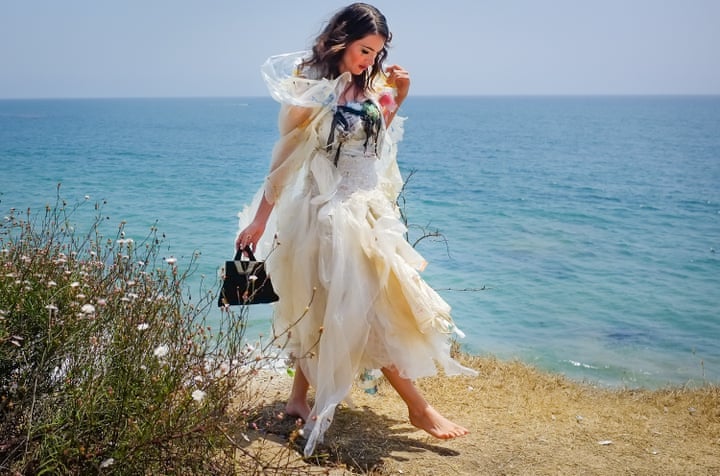
Bag Lady, modelled by Christine Spehar - Source: theguardian.com / Photograph: Monching Flores 
The 13th of September, the day the blogpost about plastic pollution was published, the headline of the Guardian caught my attention. "Trashion' designer Marina DeBris turns ocean rubbish into high-end outfits – in pictures".  Perhaps the topic was still so fresh in my mind that I was unconsciously looking for it. In any case, it is interesting enough to share it here.

The article told the story of artist Marina DeBris, who is campaigning against ocean pollution. To generate awareness for the problem she creates garments from garbage found in the ocean or at the beach. The video below gives a nice little sneak peak of her art.


Where can you see this? 


If you are by any chance in Sydney, then definitely visit her exhibition at the Bondi Pavilion Gallery at Sydney's Bondi Beach. And hurry, as you only have until the 17th of Septmeber to do so!


Stay fashionable, stay sustainable.

Until next time! 


----------------------------------------------------------------------------------------------------------------------------
References:

The Guardian. (2016). 'Trashion' designer Marina DeBris turns ocean rubbish into high-end outfits – in pictures. Retrieved from: https://www.theguardian.com/artanddesign/gallery/2016/sep/13/trashion-designer-marina-debris-turns-ocean-rubbish-into-high-end-outfits-in-pictures
Marina DeBris. (n.d.). Marina DeBris. Retrieved from: http://weadartists.org/artist/marinadebris


BYOB


Did I really just encourage my readers to bring their own beer? Well actually, no. I am sorry if I got you all excited, but I will not be throwing a party. Instead, I want to discuss a more serious topic. One that is often not directly linked to fashion pollution, but which I personally perceive as being part of the problem: Plastic. More specifically, the plastic bags we get while shopping (for instance for clothes) and the plastic fibers in our clothes. What this has to do with BYOB? You will have to read the article to find out.

So what is plastic exactly?

Plastic, according to the Britannica Encyclopaedia, is "polymeric material that has the capability of being molded or shaped, usually by the application of heat and pressure." Now let's take a step back to examine this definition a bit closer. Polymeric material means that it is a molecule that consists of multiple (semi)identical parts that are bound together. Plastic is then the polymeric material that has the property of plasticity, and can hence change in form. Some plastics are actually natural, however, most are man-made.
How we make plastics? Since plastics contain many carbon compounds, we need a carbon-rich material for that: Oil. Oil is composed of units of shorter carbon-containing parts (monomers). To create a wide range of plastics chemists have to combine different monomers and arrange them differently. Resulting in various types of plastic. For instance water bottles as you buy them in stores are often made of polyethylene terephthalate (PET), hard plastic - like in food containers - is referred to as foamed polystyrene, flexible thicker plastic - for instance, used for garden hoses - is called polyvinyl chloride(PVC), and shatterproof windows are made of polymethyl methacrylate. Most of these plastics are chemically inert, meaning that they will not chemically react with other substances such as acid, alcohol or even water. Hence, you can keep these substances in plastic containers. So plastics can hold various substances, can be molded into all kinds of forms and shapes Ã¡nd can hence be used for all kinds of purposes! What is the problem? 

The downside of plastic

Since plastic does not chemically react with most other substances, it will not decay. Hence, plastic can actually stay in the environment for centuries! With our increased use of it, it enters the environment more and more, causing a big problem. A lot of this plastic pollution ends up in our oceans, polluting the ecosystem by the fragmentation of plastic waste. A research paper by Eriksen et al. estimated that "at least 5.25 trillion plastic particles (weighing 268,940) tons are currently floating at sea". This is often referred to as the "plastic soup".


Researchers are working on developing biodegradable plastics (often made from substances such as corn oil). However, for now, most plastics are still not biodegradable, hence recycling is the best method of disposal. 


BYOB or not? 

So let me answer the burning question you all, what does plastic pollution have to do with BYOB? Well, since plastic pollution is largely caused by humans, the solution lies in our own hands. We should all start consuming a little less plastic. For instance by bringing our own water bottles and food containers or by Bringing Your Own Bag. This way we can decrease the demand for new plastic and hence decrease the production. 

So let's BYOB everyone! So that next time when you do have that beer, you can toast on a cleaner world!

Cheers! 


Stay fashionable, stay sustainable.
Until next time! 


----------------------------------------------------------------------------------------------------------------------------
References:

Eriksen, M., Lebreton, L. C., Carson, H. S., Thiel, M., Moore, C. J., Borerro, J. C., & Reisser, J. (2014). Plastic pollution in the world's oceans: more than 5 trillion plastic pieces weighing over 250,000 tons afloat at sea. PloS one, 9(12), e111913.
FREUDENRICH, C. (n.d.). How Plastics Work. HowStuffWorks. Retrieved from: http://science.howstuffworks.com/plastic.htm
Plastic. (2016). In Encyclopaedia Britannica. Retrieved from: https://www.britannica.com/topic/plastic
Polymer. (2016). In Encyclopaedia Britannica. Retrieved from: https://global.britannica.com/science/polymer