Welcome to our website !

7 non-fashion related things to do for the environment right now #2


Even though this blog is mainly focussed on fashion, making your wardrobe more sustainable will not solve the entire issue. Now, I will not talk too much about all the subparts of environmental pollution, because, trust me, there are many. However, the aim of this post will simply be to help you make your life a little more green.

1. Replace your toothbrush
What? Am I suggesting to throw something away? Well, please keep using the toothbrush you currently have until it needs replacement. But as dentists suggest to replace it every other three months (counting up to roughly 320 toothbrushes per lifetime), please consider buying a compostable wooden toothbrush (such as for instance the Plant-based Bamboo Toothbrush).

2. No more throw away plastic bottles 
If I hadn't convinced you yet through the BYOB blogpost: those one-time use plastic bottles that you can find in any grocery store are horrible (did I mention horrible?!). There are various good alternatives available, such as:  OHYO, the reusable water bottle that fits in your pocket and is BPA free! Or dopper, the reusable water bottle that is a water bottle and a cup all in one. Or the bobble, the reusable water bottle with a filter. The main message here: buy whatever bottle suits you best, however, make sure it is reusable and of course BPA free.

3. Speaking of the devil
Speaking of the devil - plastic - stop using plastic bags. Every year we produce five trillion plastic bags of which 98% ends up in landfills...  Ban plastic bags out of your life and BYOB.

4. Stop your mail subscriptions 
Most stores, if not all, will have an email subscription service available which most likely has the latest updates and hence is more relevant in general. No need for all those trees to be cut, simply so you can have the latest H&M catalogue in your hands. (bonus advantage: less clutter, more freedom)


5. Let's wrap it up 
If we're on the topic of paper waste, let's talk about wrapping paper. It is almost Christmas and that means, we will cut a lot of trees, not only to put them in our homes and decorate them, but also so we can wrap the presents that will go underneath them. About 8000 tonnes of wrapping paper are used per year, even worse, most of these end up in landfills instead of being recycled into something new. However, this is completely unnecessary. Take the opportunity to give your presents in a beautiful reusable cotton back. Or get creative with a vintage scarf. Or if you actually still have some old paper, like maps or newspapers, laying around, you know what to do!

6. Avoid eating meat
A rough 40% of the world's surface is occupied for livestock production, requiring one-third of the world's fresh water. And even though the majority of this land, approximately 30%, is used to produce grains, fruits and vegatables, these are grown to support the pigs, chicken and cattle that we consume. The fact that this land could be used more efficiently, by consuming the grains, fruits and vegatables it produces first hand, instead of through the animals we eat, is not the only problem. Through the overuse of antibiotics and the air, water and soil pollution, eating meat also poses dangers to our health and to our environment. If going all cold-turky is a bit too much for you, you could start with vegetarian Monday. Warning; as a vegetarian for most of my life, I can say that eating vegetarian can be deliciously addictive.


7. Do the dirty laundry
Petroleum-based detergent is one of the most commonly used laundry products. Unfortunately, it has some negative effects on our health and on our environment. Some of the chemicals found in detergents are left in our clothes and others end up in the sewage system, eventually contaminating our water. A substitution for this detergent problem is introduced by SmartKlean; the laundry ball; a product that cleans without using any toxic chemicals, which can be used for +/- 1000 washes. The only downside to this product is that it is made out of plastic, hence if you want to be completely sustainable you could consider making your own washing detergent, using bicarbonate soda, vinegar, water. Nevertheless, this option is already a good step in the right direction.

The general rule of thumb: Avoid plastic at all cost. 

----------------------------------------------------------------------------------------------------------------------------

Sources:

Furochic. (2010). Earth Friendly Gift Wrap. Furochic It! Retrieved from: https://www.youtube.com/watch?v=WDPZikZoXys

Herrero, M., Havlik, P., Valin, H., Notenbaert, A., Rufino, M., & Thornton, P. et al. (2013). Biomass use, production, feed efficiencies, and greenhouse gas emissions from global livestock systems. Proceedings Of The National Academy Of Sciences, 110(52), 20888-20893. http://dx.doi.org/10.1073/pnas.1308149110

Meyer, N. (2016). An Eco-Friendly Natural Alternative to Plastic Toothbrushes: Bamboo Brushes. Retrieved from: http://althealthworks.com/813/a-natural-alternative-to-plastic-toothbrushes-bamboo/

SmartKlean Corp. (2010). Official SmartKlean Laundry Ball Video. Retrieved from https://www.youtube.com/watch?v=201kSpYAN8A

Trashedfilm. (n.d.). 10 Small things. Retrieved from: http://www.trashedfilm.com/10-small-things/

Walsh, B. (2016) The Triple Whopper Environmental Impact of Global Meat Production. TIME.com. Retrieved from: http://science.time.com/2013/12/16/the-triple-whopper-environmental-impact-of-global-meat-production/

More trash


Building on the latest Sustainable Sunday Quote, this article will dive deeper into the topic of waste. In case you missed it, the quote of last Sunday was by Annie Leonard, and it stated: "There is no such thing as 'away'. When we throw anything away it must go somewhere". Rarely have I heard something so true, yet so complicated to apply. Because let's be honest, we create a lot of trash. Not only is this incredibly irresponsible due to the harmful consequences it had on the environment, but even worse; we often completely neglect the issue. Most of us simply continue our consumerist practices. However, recently I stumbled upon a documentary that might shake you awake: 'Trashed'.


Trashed
Trashed is the award-winning documentary by Candida Brady. “We buy it, we bury it, we burn it and then we ignore it." That is how the trailer of the documentary starts, summarising the core of the problem in a few, powerful words. The documentary highlights not only the harmful repercussions on the environment, it brings it a lot closer to us, by showing how our waste imposes risk on our food chain, through the pollution of our air, soil and water. To do so the star of the film, Jeremy Irons, moves from Iceland to Indonesia. Showing not only daunting images of wasteland but also giving us a sneak peak into the most beautiful corners of our world. Even though the documentary is a definite wake-up call, it ends on a positive note, showing how sustainable approaches to dealing with waste are available and making you wonder why landfills and incinerators even still exist. Next to that it shows how these sustainable approaches can provide more jobs than the current consumerist waste industry.

----------------------------------------------------------------------------------------------------------------------------


Sources:

Halpin, M. (2016). Student art goes green to celebrate Earth Day 2016. Illinois State University News. Retrieved from: https://news.illinoisstate.edu/2016/04/student-art-goes-green-celebrate-earth-day-2016/

Movieclips Trailers. (2012, May 11). Trashed Official Trailer #1 (2012) - Documentary - HD Movie. Retrieved from: https://www.youtube.com/watch?v=5z2s_klZkFg

Brady, C. (Director). (2012). Trashed [Video file]. United States: BullFrog Films.


Sustainable Sunday Quote #10


What is a goal-oriented blog without a little inspiration and motivation from time to time? Let me introduce you to the weekly Sunday rubric of Our Toxic Fashion: the Sustainable Sunday Quote. In the words of the legendary John Lennon, some say that I am a dreamer, but I am not the only one. Many clever minds before me have spoken, written or sung beautiful words that deserve to be shared. From fashionistas like Coco Channel to environmentalists like Anna Lappé, on Sundays, Our Toxic Fashion will give them a stage! Ready for the tenth one?

The Sustainable Sunday Quote


                                “There is no such thing as 'away'. When we throw anything away it must go somewhere.”

This quote by Annie Leonard addresses another part of environmental pollution: our trash. In her video Story of Stuff Annie Leonard explains that around the 1950s many goods have been designed to be obsolete, to quickly become unusable. Light bulbs are created to provide less hours of light. Phones are designed to be outdated in two to three years. These are all examples of planned obsolescence. However, there is another way to make people dispose things faster: perceived obsolescence. This is when designers make people throw things away that are still perfectly usable, by solely changing how it looks. Fashion is perhaps the best example of perceived obsolescence. Those shoes with the big platform? They can't be worn anymore in 2016, because they are so last year. You might just as well throw them away. Yeah, no.

That is where the problem comes in. As Annie said it nicely: "There is no such thing as 'away'. When we throw anything away it must go somewhere."  The average American produces 4.5 pounds of garbage per day! All of this garbage gets dumped in a landfill or gets incinerated and then gets dumped in a landfill. Both polluting the air, soil and water. Incineration is very harmful as the toxins that are used in the production stage, will be released into the air. Next to that, due to chemical reactions incinerating trash can create new toxins, like dioxin. Annie highlighted: "Dioxin is the most dangerous man-made substance known to humans and incinerators are the number one source of dioxin".  Now how do we stop dangerous pollutants from entering our environment? One of the main solutions might be stopping to produce these huge amounts of trash. Environmentalist Lauren Singer even took it that far that she is now living a zero waste lifestlye, meaning (surprisingly), that she doesn't produce any waste. Perhaps her TED talk might inspire some of you to try the same, or at least motivate you to start thinking about your own disposing behaviour.


Write it down

So from now on, shout it from the rooftops, write it on the skylines, or perhaps just make a note in your agenda: Every Sunday from now on there will be a new SSQ!


Stay fashionable, stay sustainable.
Until next time!   


Ps. Bonus points for the ones who got the lyric references hidden within the texts.  
  

----------------------------------------------------------------------------------------------------------------------------
Sources:

Halpin, M. (2016). Student art goes green to celebrate Earth Day 2016. Illinois State University News. Retrieved from: https://news.illinoisstate.edu/2016/04/student-art-goes-green-celebrate-earth-day-2016/

Linak, W. P., & Wendt, J. O. (1993). Toxic metal emissions from incineration: mechanisms and control. Progress in Energy and Combustion Science, 19(2), 145-185.

McKay, G. (2002). Dioxin characterisation, formation and minimisation during municipal solid waste (MSW) incineration: review. Chemical Engineering Journal, 86(3), 343-368.

Storyofstuffproject. (2009, April 22). Story of Stuff (2007, OFFICIAL Version) [Video file]. Retrieved from https://www.youtube.com/watch?v=9GorqroigqM

TEDx Talks. (2015, May 25). Why I live a zero waste life | Lauren Singer | TEDxTeen [Video file]. Retrieved from https://www.youtube.com/watch?v=pF72px2R3Hg


Another reason to love Stella McCartney


As a vegetarian, I am a big fan of fashion designer Stella McCartney and her philosophy. Stella McCartney, who turned her name into a British luxury brand, is well known for refusing to use any leather, fur, skins or feathers in her clothes. For Stella making ethically correct fashion is equally important as making aesthetically appealing fashion, which in my opinion is exactly the way it should be.

So recently Stella McCartney gave us another reason to love her, as she launched her first global environmental profit and loss account (E P&L). This account shows monetary worth on the ecological costs and profits generated by the direct activities of the entire supply chain over 2015. To do so the brand conducted environmental checks over the past year, analyzing the impact of her activities on natural capital.

This is something that is very innovative. Environmentalist Annie Leonard mentioned this before in her popular video Story of Stuff. She explained that many companies externalize costs. Meaning that the dress I buy for €4,95, does not cover the costs of the cotton that is produced in China, the labor costs of the girl who made the dress somewhere in Bangladesh, the storage costs of the dress, the shipping costs of the dress and eventually the salary of the staff guy who helped picking out the dress. Meaning, I don't pay for the dress. However, others pay. In China people pay by loss of resources, children in Bangladesh pay with their future as they drop out of school to work, and all around the world people pay by loss of clean air (increasing chances for asthma and cancer), all along the system people suffer from me buying the dress.

Calculating the ecological footprint 

The report looked at all aspects of the supply chain, from the production of the materials till the own activities and sales of the product. They translated this into six important categories of impact on the environment, namely:

1. The combustion of greenhouse gasses 
2. Air pollution
3. Water pollution
4. Water consumption
5. Waste disposal
6. Changes in ecosystem services associated with a change in land usage

Changing the buying process

The report shows that the brand had an environmental ‘loss’ of 5,5 million euros over the past three years, which could be translated in an 7% increase in impact on the environment because of used materials. According to Stella McCartney this is caused by the growth of the brand: Even though the general impact on the environment has increased, by changing the buying process the brand managed to decrease the average ecological footprint the past three years with 35% per kilogram of used material. The report showed that the supply chain was responsible for 90% of the environmental impact of the company. Mainly while producing resources, the environmental impact of Stella McCartney was huge, up to 57 procent. A good example of this is that they changed from using virgin cashmere to using regenerated cashmere, in the promotion video below it is explained why this change was necessary.


Through her dedication towards reducing the environmental impact, they gained great results. Personally, I think this should be a great inspiration for other (high-fashion) brands.


----------------------------------------------------------------------------------------------------------------------------
References:
Stella McCartney. (2016, July 29). Regenerated Cashmere at Stella McCartney
 [Video file]. Retrieved from https://www.youtube.com/watch?v=6oVK2pgR-G0

Storyofstuffproject. (2009, April 22). Story of Stuff (2007, OFFICIAL Version) [Video file]. Retrieved from https://www.youtube.com/watch?v=9GorqroigqM

Wackernagel, M., Onisto, L., Bello, P., Linares, A. C., Falfán, I. S. L., Garcıa, J. M., ... & Guerrero, M. G. S. (1999). National natural capital accounting with the ecological footprint concept. Ecological economics, 29(3), 375-390.

Wightman-Stone, D. (2016). Stella McCartney releases environmental profit and loss accounts. Fashionunited.uk. Retrieved from https://fashionunited.uk/news/business/stella-mccartney-releases-environmental-profit-and-loss-accounts/2016100322003


Sustainable Sunday Quote #9


What is a goal-oriented blog without a little inspiration and motivation from time to time? Let me introduce you to the weekly Sunday rubric of Our Toxic Fashion: the Sustainable Sunday Quote. In the words of the legendary John Lennon, some say that I am a dreamer, but I am not the only one. Many clever minds before me have spoken, written or sung beautiful words that deserve to be shared. From fashionistas like Coco Channel to environmentalists like Anna Lappé, on Sundays, Our Toxic Fashion will give them a stage! Ready for the ninth one?

The Sustainable Sunday Quote


                                “Fashion is so much bigger than the latest trends - it should be something that we think about as a society.”

Sara Baldwin Schatz is the founder of Fountain Square alt-boutique Lux&Ivy, a second-hand shop. In an interview with Julia Spangler she said: "My interest in secondhand goes way beyond feeling and aesthetic. I truly believe that it is the most responsible way to shop. Why waste precious resources creating new clothing that is not made to last? Especially when so much beautiful, well-made clothing is already in existence." Second-hand clothing is then also a great solution to reduce environmental pollution (caused by the fashion industry).

Unfortunately, many consumers don't feel comfortable buying second-hand clothing. A study done by Kleine, Kleine and Kernan showed that we have some we perceive our possessions as part of ourselves. Clothes, in that case, are an intimate part of our existence. This is very interesting, as it highlights our level of involvement with the objects and hence influences our acceptance or rejection towards the objects. A common connotation towards second-hand, or used clothing might be "Buying something that someone else no longer wants to wear?", creating the feeling of being less valuable than this person as the item was not good enough for him/her, but is for you. Another connotation towards used clothing might be that used clothing is "dirty". Goffman describes this as "territorial encroachment"; we fear that previously owned clothes might have body markings of the previous owner which make the item unwanted.

Therefore, it is important to explore the symbolic and psychological aspects of how we perceive second-hand clothing. Rucker et al. even suggest that research into the connotations associated with used clothing could provide insights about values attached to possessions, and hence offer insights into the world of consumption. As this is a huge part of environmental pollution (caused by fashion), this topic merits further research.

Write it down

So from now on, shout it from the rooftops, write it on the skylines, or perhaps just make a note in your agenda: Every Sunday from now on there will be a new SSQ!


Stay fashionable, stay sustainable.
Until next time!   


Ps. Bonus points for the ones who got the lyric references hidden within the texts.  
  

----------------------------------------------------------------------------------------------------------------------------
Sources:
Goffman, E. (1971). Relations in Public. New York: Basic Books.

Kleine, R. E., Kleine, S. S.,  and Kernan, J.B. (1993). Mundane Consumption and the Self: A Social-Identity Perspective. Journal of Consumer Psychology, 2 (3), 209-235.

Rucker, M., McGee, B., Alves, M., Hopkins, T., Sypolt and Watada, M. (1995). Factors Influencing Consumer Inititation of Secondhand Markets. European Advances in Consumer Research, (2), 425-429.

Solomon, M. R., (2012). Consumer behavior, buying, having and being (10th Ed.). ISBN: 9780273767312

Spangler, J. (2015). What’s It Like to Run a Secondhand Shop? Retrieved from: http://www.fairforallguide.com/2015/10/02/whats-it-like-to-run-a-secondhand- shop/


A Bunch of Pretty Things I Did Not Buy


Previous blog posts have touched upon the subject of consumerism, a topic on which the opinions are very diverse. Various economist praise consumerism as the driver of progress, yet various people are not too happy about consumerism. Not only is consumerism questionable for the price war it creates, and hence the poor labour conditions it reinforces. Various environmentalists, such as myself, have also criticised consumerism for being the main reason for depleting the earth's resources. 

Fashion is a main driver of consumerism. With the continuous renewal of trends, the fashionable society spreads the message that whatever you bought last month, can no longer be worn this month. This reinforces the idea that clothes are 'one-seasonal only' products and gives people an excuse to buy products they already have and hence, don't need. Resulting in a society in which people keep buying the same dress, top and pants, but in a slightly different colour, model or with a different print.

Illustrator Sarah Lazarovic created a book out of this issue. She was fed up with her buying habits and decided to go cold-turkey on consumerism, meaning; no shopping for a year. During this period, instead of purchasing items, she drew them. Not only did she draw the things she did not buy, she also documented her withdrawals and all the lessons she learned. This resulted in the book: A bunch of pretty things I did not buy.


In an interview with Yes! Magazine she says that the main personal gain from not buying stuff is time. Next to that she also freed herself from longing: It simply became unnecessary - as she could just use the stuff she already has. Next to this personal gain Sarah highlights that there is a bigger gain in not buying stuff. "For a long time we viewed shopping too much as merely a personal thing—bad for one’s own pocketbook and mental health, but fairly contained. In recent years, we’ve learned that the way we shop has deep social justice implications—from sweatshop fast fashion to environmental degradation and climate change." Hence, it is our responsibility to act up, not just for our personal gain - an increase in freedom and time -, but also for the world around us. There is no denying that this is a tough battle, but I am convinced it is worth it.

If you are wondering what Sarah is up to now, next to maintaining her hilarious Tumblr account, she is doing something that she calls “covet counselling” in which she helps others to stop buying. In her sessions, she asks her clients to draw the item they want to buy and talk about why the individual wants it item (emotional value) and whether the item makes a good purchase (rational value). Simply by creating a tangible image of the item, the longing to own the item often floats away. To explain this Sarah refers to Daniel Kahneman. In his book, Thinking fast and Slow, he explains that we have two ways of processing things, a fast way (emotional decisions) and a slow way (more rational decision). For shopping we mostly rely on the fast way, resulting in irrational behaviour.


----------------------------------------------------------------------------------------------------------------------------
References:
Dunn, T. (2016). A Fun Way to Stop Buying Things You Don’t Really Need. YES! Magazine. Retrieved from http://www.yesmagazine.org/happiness/a-fun-way-to-stop-buying-things-you-dont-really-need-20160908

Kahneman, D. (2011). Thinking, fast and slow. New York: Farrar, Straus and Giroux


Sustainable Sunday Quote #8


What is a goal-oriented blog without a little inspiration and motivation from time to time? Let me introduce you to the weekly Sunday rubric of Our Toxic Fashion: the Sustainable Sunday Quote. In the words of the legendary John Lennon, some say that I am a dreamer, but I am not the only one. Many clever minds before me have spoken, written or sung beautiful words that deserve to be shared. From fashionistas like Coco Channel to environmentalists like Anna Lappé, on Sundays, Our Toxic Fashion will give them a stage! Ready for the third one?

The Sustainable Sunday Quote


                                “Fashion fades, only style remains the same.”


This quote is widely overused by fashionistas all over Instagram (#fashionlover), and has thereby lost a bit of its class. However, there is definitely some truth to it. As a true fashionista knows, the trends of today, will be history by next month. And this, this is not only a problem for your wallet, but also for the environment. Because every new item you buy, will need resources, shipping to a factory, being put together in this factory and shipping to the store where it will wait for you to buy it. Not to mention what will happen if this is a trendy piece, which you might regard as useless in a month or two, and hence it will end up in a landfill or even worse an incinerator (and then in a landfill).

Write it down

So from now on, shout it from the rooftops, write it on the skylines, or perhaps just make a note in your agenda: Every Sunday from now on there will be a new SSQ!


Stay fashionable, stay sustainable.
Until next time!   


Ps. Bonus points for the ones who got the lyric references hidden within the texts.  
  

----------------------------------------------------------------------------------------------------------------------------
Sources:

Channel, C. (n.d.) Retrieved from: http://www.goodreads.com/quotes/7271638-fashion-fades-only-style-remains-the-same

Storyofstuffproject. (2009, April 22). Story of Stuff (2007, OFFICIAL Version) [Video file]. Retrieved from https://www.youtube.com/watch?v=9GorqroigqM


This is BULLSHIT!


You might be wondering: has she completely lost her mind? Well, perhaps. But that is a topic for another day. This article will actually be about bullshit. More specifically, bullshit as a resource for making fabrics. Let me introduce you to Mestic. Mestic is an organisation that wants to do something about the manure problem. How they do this? By transforming animal manure waste into materials such as bio-textiles, bio-plastics and bio-paper.

Why is there a problem? 
Across the globe, various countries are struggling with their manure surplus. Manure, in small doses, can benefit the soil. Due to its nitrogen and phosphorus it works as a fertiliser and hence, helps plants grow. However, as with everything, the amount is crucial. When the doses of manure get too big, manure can have negative repercussions on the air, on the solid and on the surface water. Next to the bad smells it produces, it can also lead to salmonella, algae blooms and E. Coli.

Preventing a manure surplus is to prevent negative outcomes sounds like the most logical thing to do, yet this is though to put into practice. The main source of manure are farm animals such as cows, which can produce around 150 pounds of manure daily. We use cows to provide us with milk and meat, in other words: cows produce food. This is where the problem comes in: people tend not to like it when somebody tries to change their eating habits.

The Craigslist of crap
One thing that is currently been done to solve the problem is the 'manure share'. In these programs, farmers share their manure with farmers and landscapers. This is a great, as it doesn't cost much but is perfect for farmers who have just a little too much manure. Giving farmers a place to bring the excess manure and helping gardeners by providing a natural and inexpensive soil fertiliser. However, this is not enough of a solution, as the surplus in manure, and hence the related environmental risk and health hazards, still exists. This is why various small organisations are trying to come up with innovative ways to limit the problem. One of these organisations is Mestic.


Mestic
Mestic creates bio-materials, such as bio-textiles, bio-plastics and bio-paper, out of manure. With their method, they convert cellulose found in manure into these biomaterials, which are ready to be processed into any kind of products. They give a short introduction about the concept in the video above.

----------------------------------------------------------------------------------------------------------------------------
References:

Bobby Born. (2016, June 23). Mestic [Video file]. Retrieved from https://www.youtube.com/watch?v=W--MlGshimY
Danovich, T. (2014). What to do with all of the poo? Retrieved from:   http://modernfarmer.com/2014/08/manure-usa/
Essaïdi, Jalila. (n.d.). Mestic. Kleding en bioplastic gemaakt van koeienmest [Translation: Mestic. Clothes and bioplastic made of manure]. Retrieved from: https://www.voordewereldvanmorgen.nl/duurzame-projecten/mestic-kleding-en-bioplastic-gemaakt-van-koeienmest

Sustainable Sunday Quote #7


What is a goal-oriented blog without a little inspiration and motivation from time to time? Let me introduce you to the weekly Sunday rubric of Our Toxic Fashion: the Sustainable Sunday Quote. In the words of the legendary John Lennon, some say that I am a dreamer, but I am not the only one. Many clever minds before me have spoken, written or sung beautiful words that deserve to be shared. From fashionistas like Coco Channel to environmentalists like Anna Lappé, on Sundays, Our Toxic Fashion will give them a stage! Ready for the seventh one?

The Sustainable Sunday Quote


                                “I don't want to protect the environment, I want to create a world where the environment doesn't need protecting.”

Write it down

So from now on, shout it from the rooftops, write it on the skylines, or perhaps just make a note in your agenda: Every Sunday from now on there will be a new SSQ!


Stay fashionable, stay sustainable.
Until next time!   


Ps. Bonus points for the ones who got the lyric references hidden within the texts.  
  

----------------------------------------------------------------------------------------------------------------------------
References:

Announcing the Dutch Sustainable Fashion Week


Tomorrow highlights the start of a very special event in the field of sustainable fashion: the Dutch Sustainable Fashion Week! From the 7th till the 16th of October sustainable fashion is promoted throughout diverse events and in various (multi-brand) stores in the Netherlands. Events like fashion shows, expositions, conferences, the Fair Fashion Festival and even an 'Aweareness Fashion shop tour'. During this tour, participants follow special shopping routes, can take part in treasure hunts, workshops and clothing swap events.

Retailers and designers have collaborated to share inspiring stories behind the sustainable clothing. The best part of the Dutch Sustainable Fashion Week will be the 10th of October, when the Dutch Design Fashion Show and the Streetwear Fashion Show will take place in Amsterdam. The after movie of last year should give you a good impression of the festivities.


While searching for international alternatives I found that, luckily, other than the fashion library, the sustainable fashion week is also implemented outside of the Netherlands. There is an Ethical Fashion Show in Berlin (from 17-19 January 2017),  the Eco Fashion Week in Seattle and in Vancouver (no date available) and the San Francisco Sustainable Fashion Week (from 11-13 November 2016).


Stay fashionable, stay sustainable.
Until next time!   

----------------------------------------------------------------------------------------------------------------------------

References: 
Eco Fashion Week. (n.d.). Retrieved from http://ecofashion-week.com/
Ethical Fashion Show Berlin. (n.d.). Retrieved from http://ethicalfashionshowberlin.com/en/
San Francisco Sustainable Fashionweek. (n.d.). Retrieved from http://sanfranciscosustainablefashionweek.org/
Urgenda. (2016, August 20). Promo Dutch Sustainable Fashion Week / DSFW 2016 | Goodbrandz Urgenda Kiesduurzamemode [Video file]. Retrieved from https://www.youtube.com/watch?v=dxpNzftQAjw


6 non-fashion related things to do for the environment right now #1


Even though this blog is mainly focussed on fashion, making your wardrobe more sustainable will not solve the entire issue. Now, I will not talk too much about all the subparts of environmental pollution, because, trust me, there are many. However, the aim of this post will simply be to help you make your life a little more green.

1. Drink a fresh cup of tea 
Personally, I am a big tea drinker and perhaps you are too. Tea is great, but tea bags are less amazing. Research shows that most tea bags are only 70/80% biodegradable. Even worse, the rest is made out of polythene terephthalate (PET), aka plastic. Now PET is has a high melting point, however, we might want to consider it's glass transition temperature (Tg), the temperature where molecules in certain materials (such as polymers) begin to break down. The problem is that where the melting point of PET is 482 degrees Fahrenheit, the Tg is about 169 degrees, which is less than the temperature of boiling water (water boils at 212 degrees)... Hence the molecules will already be in the process of breaking down while drinking tea from a PET tea bag. Not the nicest idea, is it?

When you realise that in the UK alone, 156000000 cups of tea are drunk per day (I repeat, per day!). You might realise, that is quite a few teabags. Hence, to protect yourself from consuming plastic particles you might want to replace teabags for fresh tea and use a reusable tea sieve.

2. No vacation from sustainability
Personally, I am a big fan of travelling. As a Dutch exchange student in Singapore, this is my very first time being a tourist in another continent. Before this year, I could count the times I have set food in a plane on one hand and had mostly visited tourist-focussed areas (read: sun, sea, beach). This year I experienced many culture shocks. Many of which, I could place under the umbrella term of sustainability. Now the biggest shock so far has happened to me in Bali, a place I imagined to have the cleanest and beautiful beaches of the world. Beautiful, yes. Clean? Unfortunately, I experienced with my own eyes how tourism is destroying this little piece of heaven on earth. When traveling, a lot of us seem to forget our responsibilities, including our responsibility for the earth. Chief Seattle has a simple advice for all those people: “Take only memories, leave only footprints.” 

3. Eco-traveling
Next to not participating in consumerism (even when on holidays) and not to pollute the place, you might want to look in-to eco-traveling. Eco-traveling, according to Ties, is "responsible travel to natural areas that conserves the environment, sustains the well-being of the local people, and involves interpretation and education"

4 . Leave the car 
You want to get fit ánd do something good for the environment. Leave the car behind, and take the bike instead. Or if it is a bit further away, what about public transportation? Studies show that the transport sector is responsible for 22% of CO2 emissions from fossil fuels. Light-duty vehicles, such as cars, make up 45% of that. To make it even more specific, the average car produces 4.7 metric tonnes of carbon dioxide per year. So ditch the polluting monster, ditch your car!


5. Read, read, read 
If you are a book lover like me, you probably read a lot of books. However, buying all these books in paper form is not the most environmentally friendly. Therefore, the library is my best friend. As I wrote in the post on the Fashion Library: "The concept of a library to me is great. I pay a little monthly fee - which is most likely less than I would have paid would I have bought all the books individually. Yet, I get access to a broader range of books than I could probably ever collect myself. I can stroll through the endless rows of books, and take any books with, without having any commitment - if after reading the first few chapters I dislike it, I can just bring it back without any (monetary) consequences. This allows me to pick up books I might have otherwise never picked up and explore genres I otherwise would have never explored. Amazing." And if you do want to own the books, there are still more environmentally friendly options out there. What about secondhand books? Or an E-reader?

6. Buy package free


So many things are packaged these days. I was opening a box of tea bags and found out that within the carton box each individual tea bag was packaged in a layer of plastic. Packaging over packaging is often done, to me and many others, for no clear purpose. This of course is one of the main reasons we create so much trash and is hence a topic that should be addressed. The website Beunpackaged.com already gives good insights on how to live package free and Lauren Singer also did a nice Ted Talk on living a zero waste lifestyle in which she elaborated on how to avoid buying packaged food. Basically buying a lot of things fresh, for instance from local markets, and bringing your own containers to package it, is the best way to start! 


----------------------------------------------------------------------------------------------------------------------------

Sources: 

Orci, T. (2013). Are Tea Bags Turning Us Into Plastic? The Atlantic Retrieved from:
http://www.theatlantic.com/health/archive/2013/04/are-tea-bags-turning-us-into-plastic/274482/

Composting teabags. (2010, July). Which? News. Retrieved from: http://www.which.co.uk/news/2010/07/composting-teabags-218651/

IPCC. (1996). ‘Guidelines for National Greenhouse Gas Inventories’, IPCC. Retrieved from: http://www.ipcc.ch/publications_and_data/publications_and_data_reports.shtml

Ratcliffe, S. (2011). Oxford treasury of sayings and quotations. Oxford: Oxford University Press.

TEDx Talks. (2015, May 25). Why I live a zero waste life | Lauren Singer | TEDxTeen [Video file]. Retrieved from https://www.youtube.com/watch?v=pF72px2R3Hg

The International Ecotourism Society. (n.d.). Engaging Communities, Empowering People, Inspiring Lasting Change  (Research Report). Retrieved from
the Ecotourism website:https://www.ecotourism.org/sites/ecotourism.org/files/document/ties-overview-brochure-lr.pdf 

Trashedfilm. (n.d.). 10 Small things. Retrieved from: http://www.trashedfilm.com/10-small-things/

Sustainable Sunday Quote #6


What is a goal-oriented blog without a little inspiration and motivation from time to time? Let me introduce you to the weekly Sunday rubric of Our Toxic Fashion: the Sustainable Sunday Quote. In the words of the legendary John Lennon, some say that I am a dreamer, but I am not the only one. Many clever minds before me have spoken, written or sung beautiful words that deserve to be shared. From fashionistas like Coco Channel to environmentalists like Anna Lappé, on Sundays, Our Toxic Fashion will give them a stage! Ready for the sixth one?

The Sustainable Sunday Quote


                                “The best things in life are free, the second best are very expensive...”


You might actually have heard these words before, as these are the wise words of Mahatma Gandhi. Gandhi is mainly known for his pacifist teaching of tolerance, not harming any living beings and his vegetarianism. Ever since he was born in the 19th century, he has been a great inspiration for many. Today, he was also the inspiration for this blog post. Even though the quote on first sight might have more to do with ethical fashion than sustainable fashion, in this case, the two are - in my opinion - highly connected. In the current consumer culture we are constantly striving to own the latest, the newest and the trendiest, without thinking much about the consequences, on both humans and ecosystems involved.

Starting with the ecosystems, as these not only provide us with resources but actually provide us with various services. During the Millennium Ecosystem Assesment, these services were divided into four groups: (1) producing drinkable water, (2) stabilizing the climate, (3) supporting the food chain (for instance crop pollination) and lastly (4) providing recreation for humans. This might sound rather straightforward. However, this fact that we as humans actually need our ecosystems to provide us with these services, is a fact the fashion industry often 'forgets' to take into account.

The ecosystems are being overlooked and that, all for fashion. Which brings me to the next Gandhi quote: "There is no beauty in the finest cloth if it makes hunger and unhappiness."

Write it down

So from now on, shout it from the rooftops, write it on the skylines, or perhaps just make a note in your agenda: Every Sunday from now on there will be a new SSQ!


Stay fashionable, stay sustainable.
Until next time!   


Ps. Bonus points for the ones who got the lyric references hidden within the texts.  
  

----------------------------------------------------------------------------------------------------------------------------
References:

The fashion library


Even though this blog is all about fashion, I have to admit that I have another materialistic interest: books. I really enjoy reading a little while I am in public transport, while eating breakfast or while filling in those little bits of time in between classes. A book is then also something you will most likely always find in my bag. You might wonder, why I am promoting a not so environment-friendly product. No worries, And yes, I am well aware that (paper) books are also not the most environment-friendly, that is why I love going to the library. 

The concept of a library to me is great. I pay a little monthly fee - which is most likely less than I would have paid would I have bought all the books individually. Yet, I get access to a broader range of books than I could probably ever collect myself. I can stroll through the endless rows of books, and take any books with, without having any commitment - if after reading the first few chapters I dislike it, I can just bring it back without any (monetary) consequences. This allows me to pick up books I might have otherwise never picked up and explore genres I otherwise would have never explored. Amazing. 

Source: LENA the fashion library - http://www.lena-library.com/about/ 
Now, while I was thinking about this concept, I thought how useful it would be if there was a fashion library. Just exactly the same principle, but then for clothes and accessories. And guess what, I was not the first one who got this genius idea. Even better, the concept has already been executed in my own country; the Netherlands. Amsterdam houses one of the first fashion libraries in the world. 

Angela, Diana, Elisa and Suzanne, four entrepreneurial ladies with a passion for fashion and for sustainability created LENA the Fashion Library, a fashion library for women. Their motto? Fashion has to be fun, for everyone involved. In other words, nice clothes, without harming other humans and the environment. Being able to enjoy new clothes every month, but not having to take part in consumerism and own closets full of clothes. 

Members of LENA have access to a wide range of the most beautiful vintage pieces, pieces of rising designers, sustainable labels and also; clothes brought in by people like you and me. For a set monthly fee (starting from €19.95 per month) you can change your clothes whenever you want. The only fashion you will not be able to find is fast fashion, as LENA does not support the industry and because the quality is often low. What this infinite wardrobe might look like? The video below might give a little indication. 


Personally, I think this is a great concept, which should inspire the fashion industry to be more sustainable. The succes of the fashion library shows how consumers are ready for sustainable innovation in the fashion industry. However, the fashion industry might not be willing to change the consumer culture into a sharing culture. So far, I only found a similar initiative in Belgium; Les rebelles d'anvers - a fashion library located in Antwerp. Nevertheless, this concept should spread internationally. Hence, there is much work to do!  

If you are by any chance in the Netherlands on the 19th of November and if you are curious to know more about LENA the Fashion Library, then I would highly recommend to check out the Meta Fashion Summit. The Meta Fashion Summit is a full day seminar focussing on topics like sustainability, innovation and fashion. Suzanne Smulders, one of the co-founders of LENA the Fashion Library will also present. She will explain the concept of the clothing library and how she and the other co-founders solved the challenges they faced while introducing this innovative concept. 

Unfortunately, I will not be in the Netherlands to witness this great event. However, when I am back, visiting LENA the Fashion Library will be one of the first things on my to-do list. 


Stay fashionable, stay sustainable.
Until next time! 


----------------------------------------------------------------------------------------------------------------------------
References:
Crowd Expedition. (2015, July 2). Interview with LENA the fashion library [Video file]. Retrieved from https://www.youtube.com/watch?v=tAEFWg1dnwM
Hasmik Matevosyan. (2016, September 29). Meta Fashion Summit - Interview with Suzanne Smulders [Video file]. Retrieved from https://www.youtube.com/watch?v=rbGCJHWuh24
Morgan, A. (Director). (2015). The true cost [Video file]. United States: BullFrog Films.

Sustainable Sunday Quote #5


What is a goal-oriented blog without a little inspiration and motivation from time to time? Let me introduce you to the weekly Sunday rubric of Our Toxic Fashion: the Sustainable Sunday Quote. In the words of the legendary John Lennon, some say that I am a dreamer, but I am not the only one. Many clever minds before me have spoken, written or sung beautiful words that deserve to be shared. From fashionistas like Coco Channel to environmentalists like Anna Lappé, on Sundays, Our Toxic Fashion will give them a stage! Ready for the fifth one?

The Sustainable Sunday Quote


                                “Fashion should be about challenging the status quo.”

Write it down

So from now on, shout it from the rooftops, write it on the skylines, or perhaps just make a note in your agenda: Every Sunday from now on there will be a new SSQ!


Stay fashionable, stay sustainable.
Until next time!   


Ps. Bonus points for the ones who got the lyric references hidden within the texts.  
  

----------------------------------------------------------------------------------------------------------------------------
References:

Thrifted Transformations


Reduce, reuse and recycle. These are common, but great ways, to eliminate waste and help maintain the environment and they also apply to the fashion industry. By reducing the amount of clothes you buy, reusing the clothes you already have and recycling the clothes you would have otherwise not used or even worse, thrown away, you are already well on your way to becoming an ecological shopper. Now reducing and reusing sound like rather straightforward tips, but for recycling you might need some inspiration. Luckily, there is plenty of inspiration out there.

Thrifted Transformations


Let me introduce you to April, or better known as Coolirpa, the name of her Youtube account. April is a YouTuber who loves to thrift and transforms her thrifted findings into the latest fashion. On her Youtube account, she shares these videos with her 900.000 followers, showing them all the possibilities their old clothes offer in a DIY - Do It Yourself manner. Whether it is an old blouse from your father or an old skirt from your grandma, April knows what to do.


Sustainable Sunday Quote #4


What is a goal-oriented blog without a little inspiration and motivation from time to time? Let me introduce you to the weekly Sunday rubric of Our Toxic Fashion: the Sustainable Sunday Quote. In the words of the legendary John Lennon, some say that I am a dreamer, but I am not the only one. Many clever minds before me have spoken, written or sung beautiful words that deserve to be shared. From fashionistas like Coco Channel to environmentalists like Anna Lappé, on Sundays, Our Toxic Fashion will give them a stage! Ready for the fourth one?

The Sustainable Sunday Quote

                                “Reducing our levels of consumption will not be a sacrifice but a bonus if we simply redefine the meaning of the word 'succes.' ”

Write it down

So from now on, shout it from the rooftops, write it on the skylines, or perhaps just make a note in your agenda: Every Sunday from now on there will be a new SSQ!


Stay fashionable, stay sustainable.
Until next time!   


Ps. Bonus points for the ones who got the lyric references hidden within the texts.  
  

----------------------------------------------------------------------------------------------------------------------------
References: 

Trashion

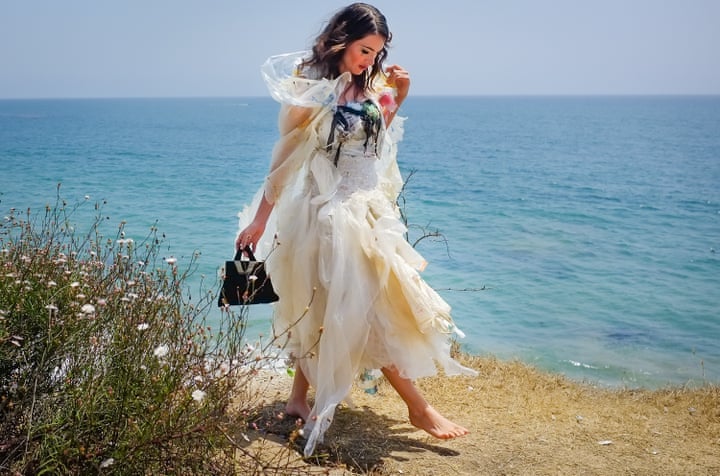
Bag Lady, modelled by Christine Spehar - Source: theguardian.com / Photograph: Monching Flores 
The 13th of September, the day the blogpost about plastic pollution was published, the headline of the Guardian caught my attention. "Trashion' designer Marina DeBris turns ocean rubbish into high-end outfits – in pictures".  Perhaps the topic was still so fresh in my mind that I was unconsciously looking for it. In any case, it is interesting enough to share it here.

The article told the story of artist Marina DeBris, who is campaigning against ocean pollution. To generate awareness for the problem she creates garments from garbage found in the ocean or at the beach. The video below gives a nice little sneak peak of her art.


Where can you see this? 


If you are by any chance in Sydney, then definitely visit her exhibition at the Bondi Pavilion Gallery at Sydney's Bondi Beach. And hurry, as you only have until the 17th of Septmeber to do so!


Stay fashionable, stay sustainable.

Until next time! 


----------------------------------------------------------------------------------------------------------------------------
References:

The Guardian. (2016). 'Trashion' designer Marina DeBris turns ocean rubbish into high-end outfits – in pictures. Retrieved from: https://www.theguardian.com/artanddesign/gallery/2016/sep/13/trashion-designer-marina-debris-turns-ocean-rubbish-into-high-end-outfits-in-pictures
Marina DeBris. (n.d.). Marina DeBris. Retrieved from: http://weadartists.org/artist/marinadebris


BYOB


Did I really just encourage my readers to bring their own beer? Well actually, no. I am sorry if I got you all excited, but I will not be throwing a party. Instead, I want to discuss a more serious topic. One that is often not directly linked to fashion pollution, but which I personally perceive as being part of the problem: Plastic. More specifically, the plastic bags we get while shopping (for instance for clothes) and the plastic fibers in our clothes. What this has to do with BYOB? You will have to read the article to find out.

So what is plastic exactly?

Plastic, according to the Britannica Encyclopaedia, is "polymeric material that has the capability of being molded or shaped, usually by the application of heat and pressure." Now let's take a step back to examine this definition a bit closer. Polymeric material means that it is a molecule that consists of multiple (semi)identical parts that are bound together. Plastic is then the polymeric material that has the property of plasticity, and can hence change in form. Some plastics are actually natural, however, most are man-made.
How we make plastics? Since plastics contain many carbon compounds, we need a carbon-rich material for that: Oil. Oil is composed of units of shorter carbon-containing parts (monomers). To create a wide range of plastics chemists have to combine different monomers and arrange them differently. Resulting in various types of plastic. For instance water bottles as you buy them in stores are often made of polyethylene terephthalate (PET), hard plastic - like in food containers - is referred to as foamed polystyrene, flexible thicker plastic - for instance, used for garden hoses - is called polyvinyl chloride(PVC), and shatterproof windows are made of polymethyl methacrylate. Most of these plastics are chemically inert, meaning that they will not chemically react with other substances such as acid, alcohol or even water. Hence, you can keep these substances in plastic containers. So plastics can hold various substances, can be molded into all kinds of forms and shapes Ã¡nd can hence be used for all kinds of purposes! What is the problem? 

The downside of plastic

Since plastic does not chemically react with most other substances, it will not decay. Hence, plastic can actually stay in the environment for centuries! With our increased use of it, it enters the environment more and more, causing a big problem. A lot of this plastic pollution ends up in our oceans, polluting the ecosystem by the fragmentation of plastic waste. A research paper by Eriksen et al. estimated that "at least 5.25 trillion plastic particles (weighing 268,940) tons are currently floating at sea". This is often referred to as the "plastic soup".


Researchers are working on developing biodegradable plastics (often made from substances such as corn oil). However, for now, most plastics are still not biodegradable, hence recycling is the best method of disposal. 


BYOB or not? 

So let me answer the burning question you all, what does plastic pollution have to do with BYOB? Well, since plastic pollution is largely caused by humans, the solution lies in our own hands. We should all start consuming a little less plastic. For instance by bringing our own water bottles and food containers or by Bringing Your Own Bag. This way we can decrease the demand for new plastic and hence decrease the production. 

So let's BYOB everyone! So that next time when you do have that beer, you can toast on a cleaner world!

Cheers! 


Stay fashionable, stay sustainable.
Until next time! 


----------------------------------------------------------------------------------------------------------------------------
References:

Eriksen, M., Lebreton, L. C., Carson, H. S., Thiel, M., Moore, C. J., Borerro, J. C., & Reisser, J. (2014). Plastic pollution in the world's oceans: more than 5 trillion plastic pieces weighing over 250,000 tons afloat at sea. PloS one, 9(12), e111913.
FREUDENRICH, C. (n.d.). How Plastics Work. HowStuffWorks. Retrieved from: http://science.howstuffworks.com/plastic.htm
Plastic. (2016). In Encyclopaedia Britannica. Retrieved from: https://www.britannica.com/topic/plastic
Polymer. (2016). In Encyclopaedia Britannica. Retrieved from: https://global.britannica.com/science/polymer